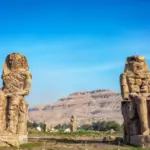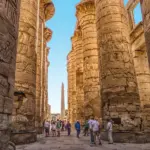
Luxor Temple tour from Hurghada takes you to the ancient world with a visit to Luxor Temple (Ipet-Reset, meaning “Southern Temple”), located in the heart of modern-day Luxor on the east bank of the Nile. It is considered one of the most magnificent and important architectural masterpieces of ancient Egypt. Unlike the vast, polytheistic administrative complex of Karnak, Luxor Temple was built for one profound royal purpose: the sacred coronation and spiritual rebirth of the living pharaoh.
Booking a specialized Luxor Temple tour from Hurghada allows you to travel from the Red Sea coast straight into the core of ancient imperial Thebes. Here, beneath towering black granite statues of Ramses II and soaring rose granite obelisks, ancient kings underwent mystical rituals during the annual Opet Festival, uniting their earthly ruler persona with the divine royal soul (Ka).
What makes Luxor Temple truly extraordinary for modern travelers is its dramatic transformation after sunset. Equipped with a state-of-the-art low-UV illumination system, the temple lights up as darkness falls over the Nile—casting long, golden shadows across sandstone colonnades and bringing ancient wall reliefs to life in a way daytime visits cannot match.
At Manolo Tours Egypt, we have crafted the ultimate Luxor Temple tour from Hurghada. By offering private VIP transfers, flexible scheduling that accommodates both daytime exploration and golden-hour sunset visits, and expert Egyptologist guides, we deliver a seamless, deeply moving historical adventure.
Why Is a Luxor Temple Tour from Hurghada Unmissable?
A dedicated Luxor Temple tour from Hurghada provides private climate-controlled transit across the desert directly to the East Bank of Luxor. Operating on a customized schedule, your tour can be timed to experience the temple during late afternoon golden hour or illuminated under night floodlights.
Guided by a private Egyptologist, you explore the Pylon of Ramses II, the Colonnade of Amenhotep III, the Sun Court, and the historic Avenue of Sphinxes—experiencing 3,400 years of unbroken human worship in one single sanctuary.
The Sacred Purpose: Divine Kingship & The Opet Festival
To fully appreciate your Luxor Temple tour from Hurghada, it is crucial to understand that ancient Egyptians did not build this sanctuary for general public worship or daily administrative priesthood functions. While nearby Karnak served as the official estate of Amun-Re, Luxor Temple (Ipet-resyt) was designed as a sacred cosmic womb dedicated to Divine Kingship (the royal Ka).
The Annual Opet Festival (Beautiful Feast of Opet):
During the height of the Nile flood season (the second month of the Akhet season), ancient Thebes celebrated the grandest religious festival of the New Kingdom.
The River Procession:
Golden barques carrying the statues of Amun-Re, his consort Mut, and their son Khonsu were transported south from Karnak down the Nile to Luxor Temple, accompanied by dancing musicians, soldiers, and crowds of cheering citizens along the riverbanks.
- The Inner Rebirth Ceremony:
Inside the dark, secluded holy chamber of Luxor Temple, the ruling pharaoh underwent secret initiation rites. The king’s physical body merged spiritually with the eternal royal Ka (the divine spark passed down from the first gods), renewing his legitimate right to rule Egypt for another year.
The Return March:
The royal barques returned to Karnak along the paved 2.7-kilometer Avenue of Sphinxes, sealing the cosmic balance (Ma’at) for the entire kingdom.
The Grand Entrance: Ramses II Pylon, Colossi & The Twin Obelisk Story
Your private Luxor Temple tour from Hurghada brings you face-to-face with one of the most imposing pylon entrances preserved in Upper Egypt. Built by Pharaoh Ramses II (19th Dynasty), this monumental stone gateway served as a symbolic barrier separating the chaotic exterior world from the divine sacred interior.
The Battle of Kadesh Wall Carvings:
The outer stone faces of the First Pylon feature deeply carved sunk-reliefs (intaglio) depicting Ramses II’s war campaigns against the Hittite Empire at the Battle of Kadesh (c. 1274 BCE). Your guide will point out the famous narrative scenes showing royal scouts, army encampments, and the king charging in his war chariot.
The Story of the Twin Obelisks:
Flanking the main portal originally stood two matching 25-meter monoliths carved from solid pink granite quarried at Aswan:
The Eastern Obelisk:
Remains standing in its original ancient position today, covered in deeply engraved hieroglyphic dedications to Amun-Re that shimmer under morning light.
The Missing Western Obelisk:
In 1830, Viceroy Muhammad Ali Pasha presented the western twin obelisk as a diplomatic gift to France. It was transported down the Nile and across the Mediterranean, and today it stands at the center of the Place de la Concorde in Paris. Exploring this site on a private Luxor Temple tour from Hurghada allows you to stand directly before the remaining twin and appreciate its true historic home.
The Great Court of Ramses II & The Abu Haggag Mosque Integration
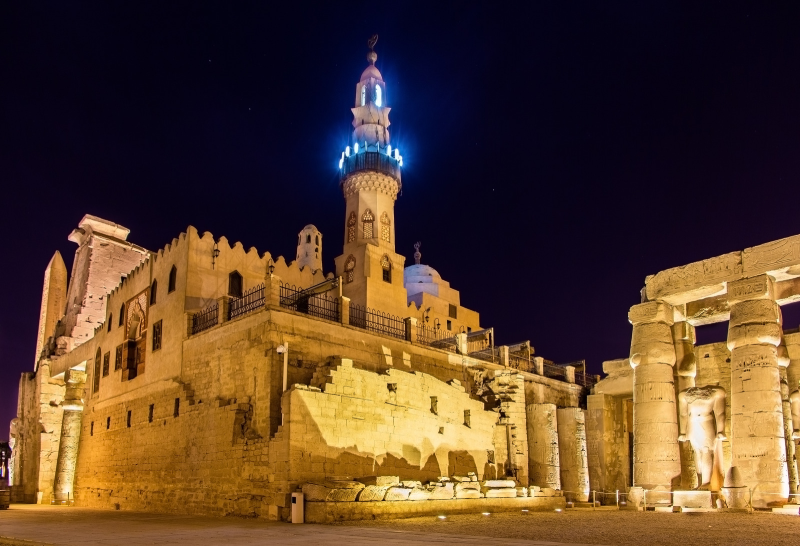
Luxor Temple Tour from Hurghada_Great Court of Ramses II
Stepping through the main pylon gateway during your Luxor Temple tour from Hurghada, you enter the Great Court of Ramses II. Measuring roughly 57 meters by 51 meters, this grand peristyle courtyard is lined with 74 papyrus-bud columns arranged in double rows, interspersed with standing colossal statues of the king.
The Statue Alignment & Royal Usurpation:
As your private Egyptologist leads you between the giant granite figures flanking the column rows, you will discover an intriguing chapter of pharaonic history. While many statues bear the name of Ramses II, physical architectural analysis reveals that several were originally sculpted during the reign of Amenhotep III or Tutankhamun.
Ramses II frequently re-carved cartouches on existing statues to claim their monumental presence for his own royal legacy—a common political strategy during the New Kingdom.
The Mosque of Abu Haggag: A Living Historical Palimpsest
High above the northeastern wall of the court sits the Mosque of Sufi Sheikh Yusuf Abu Haggag (built in the 13th century CE). This remarkable structure makes Luxor Temple one of the world’s most famous palimpsests—a site of continuous, unbroken religious worship for over 34 centuries.
Why Is the Mosque Elevated 8 Meters Up?
When the mosque was originally constructed in the 1200s CE, Luxor Temple was completely buried under centuries of accumulated desert sand, silt, and urban debris. Only the upper column capitals and pylon tops protruded above the ground. Builders erected the mosque directly on what was then ground level.
The Suspended Doorway:
When French archaeologist Auguste Mariette began excavating the temple in the 1880s, workers cleared away meters of sand, leaving the original entrance door of the mosque suspended high in mid-air along the inner courtyard wall.
Ancient Columns Inside the Prayer Hall:
Today, the mosque remains an active place of daily worship. Its interior incorporates ancient 3,300-year-old pharaonic columns directly into its prayer hall structural framework.
The Great Colonnade & Sun Court of Amenhotep III
Passing beyond the Court of Ramses II during your Luxor Temple tour from Hurghada, you step back in time to the 14th century BCE—entering the original grand axis designed by master royal architect Amenhotep (son of Hapu) for Pharaoh Amenhotep III (18th Dynasty).
The Great Colonnade Hall (The Processional Way):
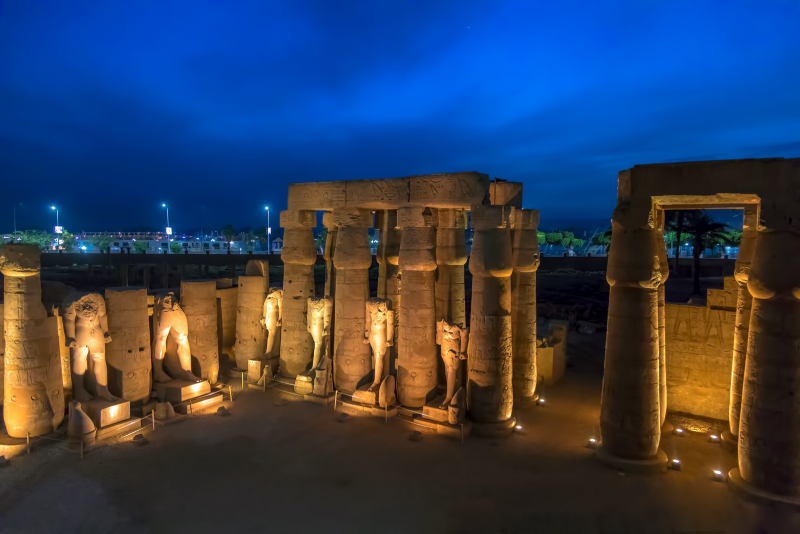
Luxor Temple Tour from Hurghada_Great Colonnade Halll
This soaring 100-meter-long corridor consists of 14 massive sandstone columns standing 16 meters (52 feet) tall, topped with open papyrus capitals that echo the central aisle of Karnak’s Hypostyle Hall.
- The Opet Relief Wall Narratives:
The long side walls flanking the colonnade—initiated by Tutankhamun and completed by Horemheb—contain the world’s most detailed visual documentation of the Opet Festival:
- West Wall:
Depicts the energetic departure of the sacred barques from Karnak Temple, showing priests bearing the gilded boats on their shoulders, acrobats performing backflips, and trumpeters leading the royal army.
- East Wall:
Documents the joyful return journey to Karnak, complete with sacrifice offerings of cattle, incense burning, and crowds feasting along the Nile banks.
The Sun Court (The Peristyle Court):
Stepping through the colonnade brings you into the spacious Sun Court of Amenhotep III, measuring 45 meters by 56 meters. Surrounded on three sides by a double row of elegant papyrus-bud columns, this court represents the absolute pinnacle of 18th Dynasty architectural balance and geometric symmetry.
The Inner Sanctuary: Alexander the Great & Roman Shrine Layers
Beyond the Sun Court lies the most sacred, secluded zone of Luxor Temple—the Hypostyle Antechamber and the Inner Holy of Holies.
The Roman Tetrarchic Chamber:
In the late 3rd century CE, Roman occupiers converted the inner antechamber into an imperial cult chapel for Emperor Diocletian. Workers covered the ancient Egyptian wall reliefs with a layer of painted plaster featuring Roman-style frescoes. Today, careful restoration reveals both historical layers simultaneously—Roman legionaries standing beside ancient Egyptian gods.
The Chapel of Alexander the Great:
At the absolute center of the inner sanctuary stands the granite barque shrine rebuilt by Alexander the Great (332 BCE). To solidify his legitimacy over Egypt, Alexander had himself depicted on the chamber walls as a traditional Egyptian pharaoh presenting offerings to Amun-Re—a fascinating cultural fusion you explore firsthand during your Luxor Temple tour from Hurghada.
The Magic of Luxor Temple at Night: Lighting & Atmosphere
While most pharaonic monuments across Egypt close their gates at dusk, Luxor Temple offers one of the most mesmerizing nocturnal experiences in the ancient world. Booking a private Luxor Temple tour from Hurghada with an evening or late-afternoon itinerary allows you to witness the dramatic transition from sunset to full night illumination.
The Low-UV Illumination System:
The Supreme Council of Antiquities installed a specialized, low-UV LED illumination network designed specifically to highlight the contours of 3,400-year-old stone figures without emitting heat or light wavelengths that degrade organic stone pigments.
Night Visual Highlights:
The Glowing Front Pylon:
The colossal seated statues of Ramses II cast long, commanding shadows against the illuminated stone facade, while the 25-meter rose granite obelisk glows brilliantly against the dark night sky.
The Forest of Golden Light:
Walking through the Colonnade of Amenhotep III at night places you between soaring columns illuminated from below, creating a cinematic sense of scale that feels entirely different from daytime visits.
Combining Luxor Temple with the Avenue of Sphinxes to Karnak
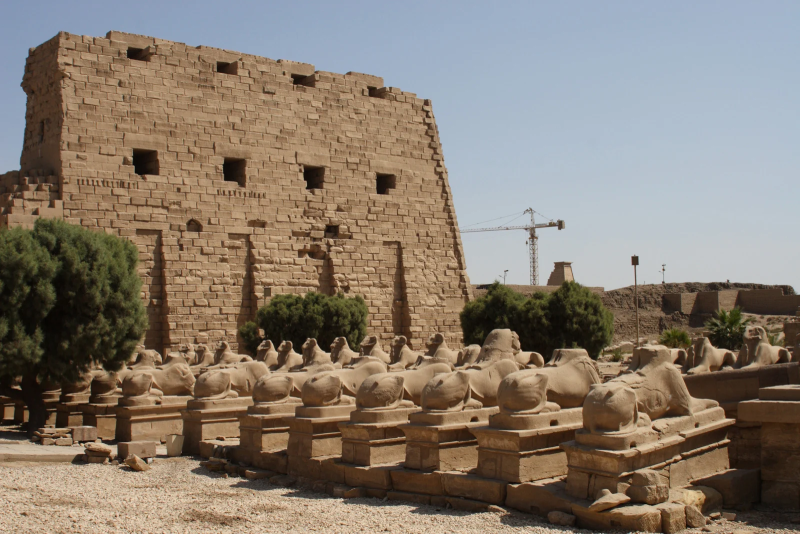
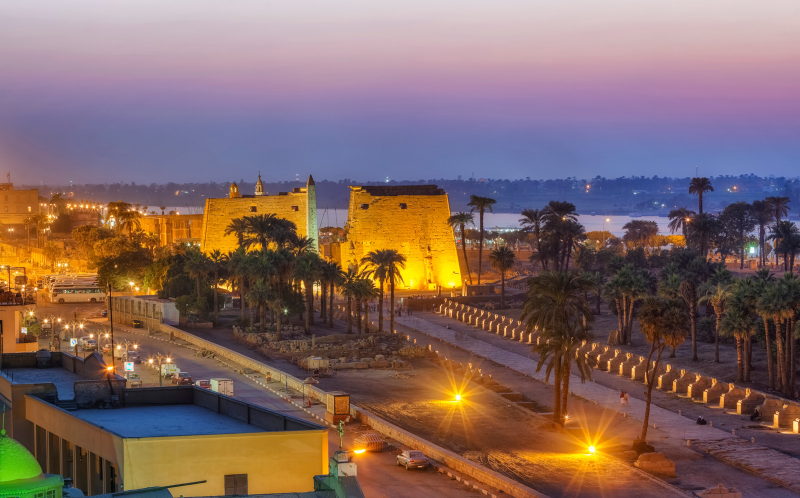
Luxor Temple Avenue of SphinxesTour from Hurghada__
Standing at the entrance of Luxor Temple brings you directly to the southern terminus of the world-famous Avenue of Sphinxes (Wadjet-Amon).
How to Experience It on Your Private Tour:
Your Manolo Tours Egypt guide will walk you along the initial restored section of the avenue directly in front of Luxor Temple’s main pylon. Here, you can examine the carved stone sphinxes up close, take advantage of uncluttered photography angles, and trace the exact path ancient royal processions followed during the Opet Festival.
Driving from Hurghada to Central Luxor
Executing a seamless, stress-free Luxor Temple tour from Hurghada relies on precise highway transit through the Eastern Desert, bringing you straight into the central urban waterfront of Luxor on the East Bank of the Nile.
Central Urban Accessibility Advantage:
Unlike sites tucked deep in isolated desert valleys, Luxor Temple is situated right on the Nile River Corniche in central Luxor. A private Luxor Temple tour from Hurghada allows you to step directly out of your private vehicle onto the modern paved plaza, making access quick, smooth, and effortless for visitors of all ages.
Financial & Ticket Surcharge Transparency
Understanding the official entrance fee structure and ticket window policies enforced by the Ministry of Tourism & Antiquities ensures zero surprises at the site gate:
- Main Luxor Temple Entry Pass
The main admission ticket provides full access to all core architectural areas of Luxor Temple. Visitors can explore the monumental First Pylon, the grand Court of Ramses II, the soaring 14-column Processional Colonnade of Amenhotep III, the sprawling Sun Court, the sacred Inner Sanctuaries, and the open plaza connecting to the Avenue of Sphinxes. This complete entry pass is fully included in your Manolo Tours private package price.
- Night Illumination Entry
Luxor Temple is famous for its evening atmosphere when the monuments are lit up after dusk. Your standard general admission ticket covers both daytime and nighttime operating hours—no separate evening pass is required. Visitors holding a valid daily ticket can experience the illuminated statues, relief walls, and columns without paying an additional entry fee.
- Official Gate Payment Policy
The ticket windows at Luxor Temple operate under a strict digital transaction policy. All entry passes, permits, and tickets must be purchased using a credit or debit card (Visa or Mastercard). Physical cash currency is no longer accepted at the site ticket booths under any circumstances.
FAQs
What makes a Luxor Temple tour from Hurghada unique compared to other site tours?
Unlike funerary tombs or sprawling administrative complexes, Luxor Temple was built specifically for the ritual coronation and spiritual rebirth of the living pharaoh (the royal Ka) during the annual Opet Festival.
Can I visit Luxor Temple at night on a tour from Hurghada?
Yes! Luxor Temple remains open into the evening under a state-of-the-art low-UV illumination system, allowing visitors to experience glowing black granite statues, soaring illuminated columns, and dramatic shadow displays after sunset.
Why is there a mosque inside Luxor Temple?
The Mosque of Abu Haggag was built in the 13th century CE directly on top of pharaonic ruins when the temple was buried under meters of desert sand. Today, it stands as proof of over 3,400 years of continuous active worship inside the complex.
Where is the second obelisk of Luxor Temple located?
While the Eastern rose granite obelisk stands at the entrance of Luxor Temple today, its western twin was presented to France in 1830 and now stands at the Place de la Concorde in Paris.
Is photography allowed during a Luxor Temple tour from Hurghada?
Yes! Smartphone photography is 100% free throughout the entire temple complex during both day and night hours. Tripods and professional DSLR setups require a commercial photography permit.
Can I walk from Luxor Temple to Karnak Temple along the Avenue of Sphinxes?
Yes. The newly restored 2.7-kilometer Avenue of Sphinxes connects Luxor Temple directly to Karnak Temple. Private tours allow you to explore key sections of this ancient processional highway.
How far is Luxor Temple from Hurghada by car?
The direct highway travel time from Hurghada to Luxor Temple in central Luxor is approximately 3.5 to 4 hours each way via a private, climate-controlled vehicle.
Can I buy entrance tickets at Luxor Temple with physical cash currency?
No. Official ticket booths at Luxor Temple strictly operate on a card-only payment policy (Visa or Mastercard). When you book with Manolo Tours Egypt, all entry passes are pre-arranged seamlessly.
Is Luxor Temple accessible for visitors with limited mobility?
Yes. Luxor Temple features flat, paved sandstone and gravel walkways with smooth, gentle ramps throughout the entire main axis, making it one of the most accessible monuments in Egypt.
Can a Luxor Temple tour from Hurghada be combined with Karnak Temple and the West Bank?
Yes! A private full-day tour with Manolo Tours Egypt easily integrates Luxor Temple, Karnak Temple, and West Bank treasures like the Valley of the Kings into one master itinerary.
Key Takeaways
A private Luxor Temple tour from Hurghada takes you to the sacred ceremonial site where ancient Egyptian pharaohs underwent divine coronation and spiritual renewal.
Stand before the colossal seated statues of Ramses II, the 25-meter rose granite obelisk, and the 14 soaring columns of Amenhotep III’s Great Colonnade.
Experience the 3,400-year multi-religious heritage of the site, from ancient Egyptian reliefs to Roman frescoes, Coptic Christian elements, and the active Mosque of Abu Haggag.
Evening itineraries unlock the magical spectacle of Luxor Temple illuminated under night floodlights.
Book Your Private Luxor Temple Tour Today
Ready to stand beneath the glowing statues of Ramses II, walk the historic Avenue of Sphinxes, and experience the timeless power of ancient Thebes with VIP execution? Reserve your excursion with Manolo Tours Egypt today.